

An evening of Turkish, Kurdish, Armenian, and Syriac music in Germany opens a much larger question: What happens to a society when generations are taught to forget the people, languages, and histories that once shaped it? A reflection on Anatolia’s wounded memory, the psychology of belonging, and the possibility of reclaiming a shared past.
Can a melody remember what people have forgotten?
Can a song carry the memory of a language no longer spoken, a neighborhood that no longer exists, or a community that disappeared from the place it once called home?
And why does a melody sometimes feel familiar even when we do not understand a single word?
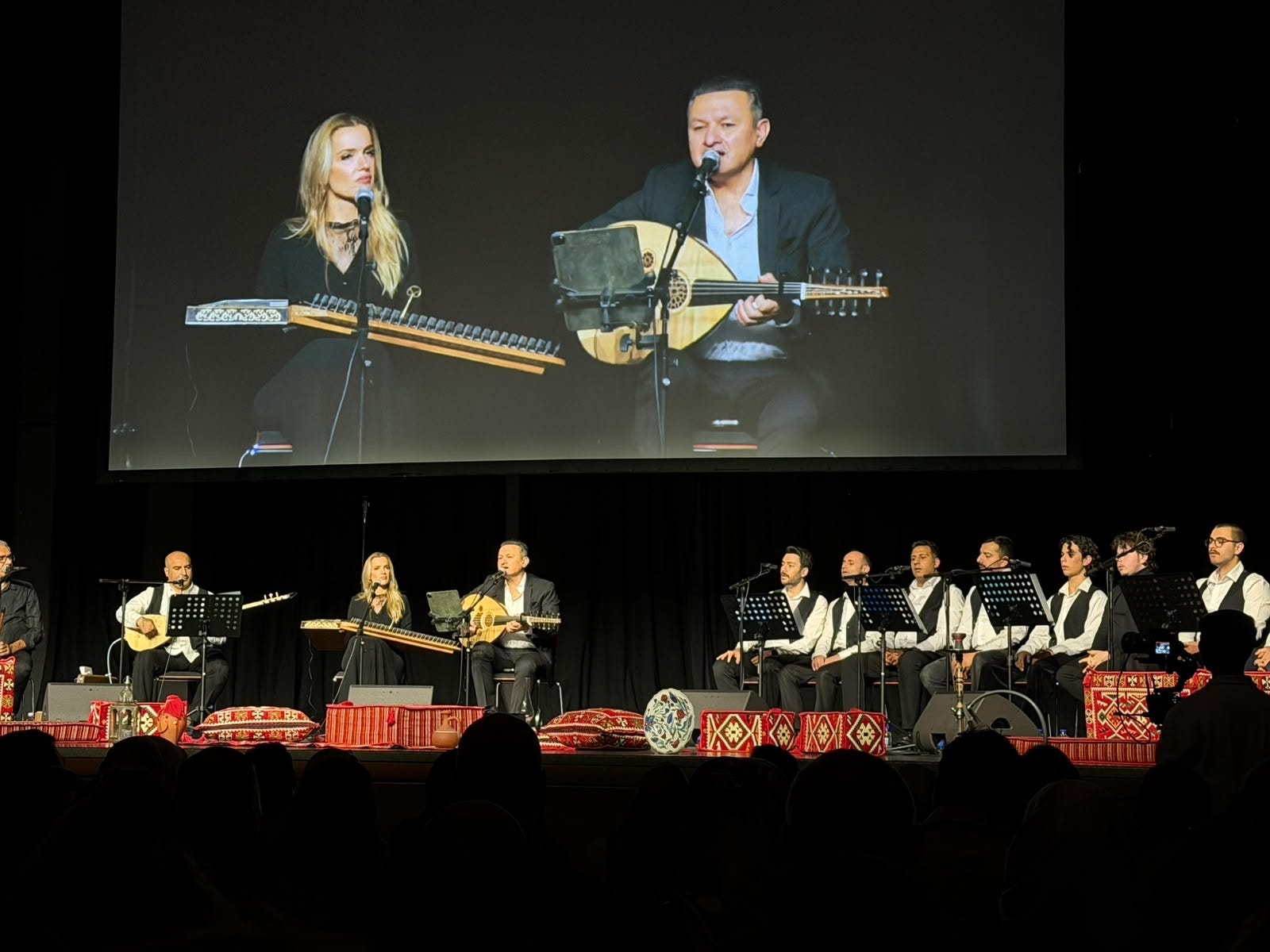
I found myself thinking about these questions on Sunday evening, October 11, at a concert in Cologne, Germany. On stage was Ertuğrul Erkişi, a Turkish musician known for drawing on the rich musical traditions of Anatolia and Mesopotamia.
At one point, Erkişi picked up his saz, a traditional long-necked string instrument, and began telling a story.
Perhaps, he suggested, the mother of a prophet had once whispered this melody to her child before placing him in a river to save his life. Perhaps Alexander the Great’s soldiers had heard it while passing through the fields of ancient Mesopotamia. Perhaps it had been played centuries later at the table of Saladin.
These were not historical claims. They were imagined possibilities, a way of expressing something that history books struggle to capture: the extraordinary journeys that music can make through human lives.
Within minutes, civilizations separated by centuries, borders, religions, and empires seemed to inhabit the same melody. Then came the songs. Turkish. Kurdish. Armenian. Syriac.
Languages whose speakers had shared cities, villages, markets, and landscapes for generations. Languages that had also been divided by violence, forced migration, political repression, and competing national identities.
For a few hours, they occupied the same stage again. My dear friend, journalist Gülizar Baki, was in the audience that evening. In her account of the concert, she describes the strange familiarity of hearing a folk song she knew well performed in the Armenian dialect of Diyarbakır, a city in southeastern Turkey with a deeply layered Armenian, Kurdish, Syriac, and Turkish history.
Listening to another melody in Syriac, the language associated with an ancient Christian tradition rooted in the Middle East, she felt almost as though she already understood it.
I was there, too.
And what struck me most was precisely that sensation: the recognition of something I had never consciously known. I am a third-generation German-Turk. Deutschtürkisch, as I would describe myself in German. I have never lived in Turkey.
Germany is the country where I grew up, discovered the world, learned to think, and found my voice. Turkey belongs to my family’s history, to the language I share with my mother, and to the cultural memories carried across generations.
I have never felt the need to choose between these two forms of belonging. I do not live between two cultures. I speak from within both. And perhaps that is why I know, not only through academic research but through lived experience, that no culture can ever be contained within a single identity.
That evening, the sense of familiarity I experienced while listening to songs in languages I did not understand was not simply nostalgia for a country in which I had never lived.
It was something more difficult to describe. It was the discovery that the cultural world I had inherited contained far more people, languages, and histories than I had ever been taught to recognize.
We cannot literally remember a past we never experienced. But perhaps we can recognize what that past has left behind. And perhaps that is where cultural memory begins.
The Many Lives of One Homeland
Anatolia, the vast peninsula that makes up most of modern-day Turkey, is frequently described as a bridge between East and West, a cradle of civilizations, or a meeting point of religions and cultures.
Mesopotamia, the ancient region stretching principally across present-day Iraq and parts of neighboring countries, is similarly celebrated as one of the birthplaces of human civilization.
These descriptions are not wrong. But they have become so familiar that we rarely pause to consider the human stories behind them.
For centuries, Anatolia and its surrounding regions were home to overlapping communities of Armenians, Greeks, Kurds, Turks, Syriac Christians, Jews, Arabs, and many others. Their relationships were never uniformly peaceful or equal. They lived under changing empires, legal hierarchies, religious institutions, and political systems.
Yet their cultures did not develop in isolation.
They borrowed from one another. They influenced one another. And sometimes they became so deeply intertwined that separating them into distinct national traditions is almost impossible.
A melody could travel from one community to another, acquiring new lyrics along the way. A lament might survive in a language different from the one in which it was first sung. Wedding rituals, recipes, stories, expressions, and everyday customs moved across religious and linguistic boundaries.
A child might grow up hearing a lullaby containing traces of a language no one in the family spoke anymore. These cultural exchanges did not require people to share the same religion, ethnicity, or political identity.
Human beings were connected long before modern states sought to define precisely who belonged where. And this is where the story becomes more troubling.
Because the history of Anatolia is not simply a history of cultural diversity. It is also a history of what political power has done to that diversity.
The rise of modern nationalism, the collapse of the Ottoman Empire, and the creation of the Turkish Republic in 1923 transformed the relationship between identity, language, and political belonging.
Like many nation-building projects, the construction of a unified national identity involved the promotion of a common language, history, and sense of collective origin.
But this search for unity also encouraged the marginalization of differences that did not fit the dominant national narrative.
Diversity could become a political problem. Difference could be interpreted as disloyalty. And identities that had existed for centuries could suddenly be treated as obstacles to national cohesion.
The consequences were profound.
The Armenian genocide of 1915 destroyed much of the Armenian presence in the Ottoman Empire. The compulsory population exchange between Greece and Turkey, agreed in 1923, uprooted large Greek Orthodox and Muslim populations from their homes on either side of the Aegean. Syriac Christian communities experienced violence, displacement, and successive waves of emigration. Kurdish language and identity faced decades of restrictions and assimilationist policies.
Turkey’s later history also saw forms of exclusion directed at religiously observant citizens, including restrictions that affected women’s access to education and public employment because of their headscarves. In other periods, political power and social hostility were turned - and unfortunately is still turning- against people previously associated with influential religious movements.
These histories are not equivalent. They differ in their causes, magnitude, forms of persecution, and consequences. They should never be collapsed into a single undifferentiated account of suffering.
But together they reveal something important about the relationship between political power and collective memory: Anatolia did not lose only people. It lost part of the vocabulary through which it understood itself.
Languages once heard on the same streets gradually disappeared from public life. Neighborhoods changed names. Buildings acquired new occupants. Family histories were interrupted. Some memories survived only in private conversations; others could no longer be spoken aloud.
What remained might be a house, a recipe, an old photograph, a family name, or a melody whose origins had become uncertain.
And when we hear a familiar song performed in another language today, our surprise may reveal more about the history we have been taught than about the history that actually unfolded.
Perhaps the remarkable thing is not that these cultures once shared so much. Perhaps it is that we have come to imagine them as strangers.
The Hidden Price of Belonging
There is a psychological dimension to this history that deserves closer attention.
Canadian physician and author Gabor Maté has explored a fundamental tension in human development: the need for attachment and belonging, and the need for authenticity: the ability to remain connected to one’s own feelings, needs, and identity.
Especially during childhood, human beings depend on relationships for safety and acceptance. Under certain conditions, maintaining those relationships can come at a cost. A person may learn to suppress parts of themselves to preserve the bonds on which they depend.
Maté’s work concerns individual psychology. It should not be treated as a universal theory of political behavior or applied mechanically to entire societies. But the tension he describes opens an important question about collective identity.
What happens when belonging to a community requires people to distance themselves from parts of their own history? What must a person surrender to be accepted? A language? A name? A religious tradition? A family memory?
Or perhaps something less visible: the freedom to ask questions that might disturb the story a community tells about itself.
Social psychology has long shown that belonging is not merely a matter of avoiding rejection. Group membership can provide meaning, dignity, security, and a sense of purpose. People may adopt group norms because they genuinely value the group and want to see themselves as part of it.
This is not limited to minorities. Members of majority communities are also shaped by expectations about loyalty, identity, and acceptable interpretations of the past.
A national identity can give people a meaningful sense of shared history. But it can also narrow the range of histories they feel able to acknowledge.
Consider a child growing up in a town where Armenian, Greek, or Syriac families once lived.
The child may learn about national victories, wars, and founding heroes. They may know the names of military commanders and political leaders. Yet they may learn almost nothing about the people who once lived on their street, the languages spoken in the local marketplace, or why particular communities are no longer there.
The child is not necessarily being taught to hate those people. Sometimes the lesson is more subtle. They are simply never introduced to them. And what is never introduced can eventually become almost impossible to imagine. This is one of the most unsettling consequences of selective collective memory.
A society can lose important parts of its history without even recognizing the loss.
The narrowing of cultural memory does not affect only the communities whose stories are excluded. It also impoverishes the imagination of those who remain. They inherit a smaller understanding of their own world.
They may know the official story of where they come from while remaining unaware of how many other lives made that place what it was. And over time, the absence itself can begin to feel natural.
The Anatomy of a Wounded Memory
French sociologist Maurice Halbwachs argued that memory is not simply an individual possession. It is shaped by the social worlds in which we live: families, institutions, communities, and the narratives through which societies understand themselves.
We do not remember in isolation. We learn what deserves remembrance. We learn which historical events should inspire pride, which should be mourned, and which are considered too uncomfortable to discuss.
Schools, museums, public commemorations, monuments, newspapers, and television all participate in this process. So does silence.
Collective forgetting is not always the natural fading of memory over time. Sometimes it is the consequence of selective remembrance. A nation may commemorate one community’s suffering while barely acknowledging another’s. The names of some heroes may become familiar to every schoolchild, while the losses of other groups survive only in family stories.
In this way, people can inhabit the same country while living with profoundly different understandings of its past.
This brings me to what I would call a wounded consciousness. I do not mean that a society can be given a clinical diagnosis of trauma. A nation is not an individual patient, and historical suffering cannot be reduced to a psychological condition.
Rather, I am interested in what happens when the relationship between a society’s lived history and its publicly acknowledged history becomes fractured.
A wounded consciousness is not always expressed through remembered pain.
Sometimes it appears as an inability to recognize that pain in others. Sometimes it is the discomfort produced by an unfamiliar account of familiar history. Sometimes it is the instinct to interpret another community’s memories as an accusation against one’s own identity.
And sometimes it is the absence of curiosity itself: A family may never speak about a relative who disappeared. Another may preserve a fear whose origins the younger generations do not understand. In one community, a particular place name may evoke pride; in another, the same name may recall loss or displacement.
Not every silence is imposed by political power. Some are shaped by grief, shame, protection, or the simple difficulty of finding words.
Nor does historical trauma pass automatically from one generation to the next in the same form. Its effects depend on individual experiences, family relationships, and social conditions.
But the relationship between past and present is rarely as distant as we imagine.
What a society refuses to remember may continue to shape what its people are able or willing to understand.
It can influence whose suffering is considered legitimate, whose fears appear reasonable, whose historical claims are heard with sympathy, and whose stories are dismissed before they are told.
This is why collective memory is not merely a question for historians. It is also a question for democracy.
A society’s capacity to accommodate difference depends, in part, on its willingness to recognize that the past may look different from another person’s perspective.
And that willingness becomes especially difficult when historical narratives are closely tied to national pride, political loyalty, or moral innocence. We would often prefer a past that confirms our identities. But understanding history requires something more demanding: allowing it to complicate them.
When Loving a Culture Is Not Enough
Back in Cologne, the music continued.
Ertuğrul Erkişi’s wife, Aslıhan Erkişi, accompanied the performance on the qanun, a traditional plucked string instrument widely used across the Middle East. She also performed an Armenian lament.
A choir and instrumental ensemble made up of music enthusiasts from different professional backgrounds across Europe brought remarkable warmth and harmony to the evening. At moments, the audience joined in.
There was something deeply moving about hearing these traditions presented not as rival claims of ownership, but as parts of a shared musical world. Yet as I listened, another question began to take shape: What does it actually mean to celebrate another culture? We can be moved by an Armenian lament without taking an interest in the Armenian genocide. We can applaud a Kurdish song while avoiding questions about the long history of restrictions on Kurdish language and cultural expression in Turkey. We can describe Syriac music as a precious part of the region’s heritage while knowing almost nothing about why so many Syriac Christian communities left their ancestral homes.
We can admire what a culture has produced without being willing to confront what happened to the people who produced it. There is a troubling asymmetry here.
We are often more comfortable celebrating cultural diversity than acknowledging the histories of exclusion that have threatened it. And this problem extends far beyond Anatolia.
Around the world, societies routinely embrace the food, music, clothing, and artistic traditions of communities whose political struggles remain marginalized. A culture may be welcomed as entertainment while its people continue to struggle for recognition.
A language may be celebrated at a festival while its speakers encounter barriers in schools, institutions, or public life. Multiculturalism, understood merely as the coexistence of different cultural expressions, can therefore become surprisingly superficial.
We enjoy the diversity around us without necessarily accepting the responsibilities that come with it. But cultural recognition is not simply a matter of appreciating what other people contribute to our lives. It also means recognizing their right to exist as themselves. It means accepting that their histories may challenge our assumptions. It means understanding that a shared cultural inheritance does not erase unequal experiences of power.
This does not require everyone to agree on every historical interpretation. Nor does it demand that individuals inherit personal guilt for everything committed in the name of communities to which they belong.
It requires something both simpler and more difficult: intellectual openness, historical seriousness, and the willingness to listen. One of the measures of a mature society is not how confidently it celebrates its own identity.
It is how much room that identity leaves for the memories of others.
A New Generation, a Different Kind of Belonging
There is another reason why the concert in Cologne affected me so deeply. It took place in Germany. For an international audience, this detail matters.
On October 30, 1961, West Germany and Turkey signed a labor recruitment agreement that would help transform both countries. West Germany needed workers for its rapidly expanding postwar economy. Turkey faced economic pressures and unemployment. The workers who arrived became widely known as Gastarbeiter, or guest workers.
The term itself revealed an assumption: they were expected to be temporary. Many were not.
They built families, opened businesses, established communities, and became part of German society. Their children and grandchildren grew up speaking German, attending German schools, and developing identities shaped by both their inherited family histories and the country in which they lived.
But there is something about this migration history that is often overlooked.
The people who came from Turkey were never culturally homogeneous. They included Turks and Kurds, people of different religious traditions, and families whose histories reflected the extraordinary complexity of Anatolia itself. They did not all share the same language, politics, memories, or understanding of their country of origin.
In Germany, people whose communities had lived apart or had been driven apart could find themselves inhabiting the same cities again.
Their children could attend the same schools. They could encounter one another at universities, in workplaces, at cultural events, or in the ordinary routines of urban life. Of course, migration does not automatically dissolve inherited divisions.
Prejudices cross borders. Political conflicts travel with communities. Historical resentments may survive for generations, sometimes acquiring new meanings in the diaspora. But migration also creates possibilities that did not exist before.
The second or third generation does not necessarily have to organize its identity around precisely the same boundaries that shaped its parents’ and grandparents’ lives. For me, being German-Turkish is not a condition of permanent cultural suspension.
I am not standing between two countries, unable to decide where I belong. My life is not an unfinished journey from one identity toward another. It is a life rooted in Germany, informed by an inherited cultural world that stretches far beyond any single national narrative. And this distinction matters.
The language of integration often assumes that people begin outside a society and must gradually find their way into it. But what does that framework mean for a third-generation person who has never lived anywhere else?
What does it mean to be asked where one truly belongs when one’s memories, friendships, education, and everyday experiences are already part of the country in question? And why should cultural inheritance be understood as something that makes belonging less complete?
For younger generations, identity may be less about balancing two supposedly separate worlds than about recognizing that both have already become part of a single lived experience.
Seen in this light, the concert in Cologne was not an exercise in remembering a distant homeland. It was an encounter with historical layers already present in the lives of people who call Germany home.
The Armenian lament, the Kurdish folk song, the Turkish melody, and the Syriac hymn were not simply fragments of an elsewhere. They were also part of the cultural landscape of contemporary Germany. And that changes the question.
Rather than asking how much of their ancestral homeland younger generations can preserve, perhaps we should ask what new ways of understanding that inheritance become possible when it is experienced from a different social position.
Distance can sometimes create room for questions that proximity makes difficult. Younger generations may begin to examine inherited identities without feeling obliged to reproduce every inherited division.
They can recognize the value of a cultural tradition while questioning the historical silences surrounding it. They can acknowledge the suffering of communities their own families may never have known. They can discover that understanding someone else’s past does not require abandoning their own.
Cultural inheritance remains alive not because each generation preserves it unchanged, but because each generation finds new ways to understand it.
And perhaps this is one of migration’s less appreciated possibilities. It can create not only new homes, but new ways of remembering.
The Courage to Remember Differently
There is a temptation, when confronting histories of division, to imagine that the past was once more harmonious than the present. Anatolia lends itself especially easily to such romantic narratives.
We picture bustling marketplaces where many languages were spoken, neighborhoods where different faiths coexisted, and families whose lives were connected through trade, friendship, food, and music. Some of these scenes reflect genuine experiences of coexistence. But they are not the entire story.
The region’s history was also marked by hierarchies, inequalities, conflict, persecution, and forced separation. Communities influenced one another without necessarily enjoying equal rights or equal security.
Shared cultural life did not eliminate political domination. We should therefore resist replacing one simplified historical narrative with another.
The answer to a history that has denied diversity is not a sentimental story in which diversity always meant harmony. What we need is the courage to recognize complexity.
To acknowledge that people could share music while holding prejudices against one another. That neighbors could participate in common cultural traditions while living under unequal political conditions. That the same city could represent belonging to one family and displacement to another. That a society can contain genuine experiences of solidarity alongside profound injustices. This is what makes confronting history so difficult.
It asks us to give up the comfort of a single, uncomplicated story. And it brings us back to the tension between belonging and authenticity. At the individual level, the need to remain accepted by a group can sometimes discourage people from acknowledging uncomfortable truths about themselves.
At the societal level, something comparable can happen when a collective identity becomes dependent on a particular understanding of history. If recognizing another community’s suffering feels like a threat to our own belonging, then belonging itself has become too fragile. If hearing a different account of the past immediately produces defensiveness, perhaps the problem is not the existence of competing memories.
Perhaps it is the belief that only one memory can be legitimate. A society does not become weaker because it acknowledges the injustices within its history. Nor does a culture become less meaningful because we discover how profoundly it has been shaped by others.
The courage to confront the past is not an act of disloyalty. It may be one of the deepest expressions of responsibility toward the society to which we belong.
Let us remember so that we may confront the past. Let us confront it so that we may heal.
These words are not a promise that historical wounds can be repaired simply by speaking about them.
Reconciliation is neither automatic nor guaranteed. It requires knowledge, accountability, recognition, and often difficult political and social change. But silence cannot be the foundation of genuine understanding.
A healthier relationship with history begins when we are prepared to ask questions that may complicate the stories we inherited.
Who lived in these streets before us? What languages once filled these neighborhoods? Who left, and under what circumstances? Who never returned? What did those who remained remember? What did they learn to forget?
And how much of what we now call our cultural identity was shaped by people whose names have disappeared from its official history? These questions matter far beyond Turkey.
From societies confronting the legacies of colonialism and slavery to countries divided by ethnic conflict, migration, or authoritarian rule, the struggle over collective memory remains deeply connected to the question of who belongs.
The circumstances differ, and their histories must be understood on their own terms. But the underlying challenge is recognizable.
Can people construct a shared future without insisting on a single, exclusive account of the past?
Can a community acknowledge another’s suffering without treating that acknowledgment as a defeat?
Can belonging become strong enough to tolerate historical truth? Perhaps this is one of the most important tests of social maturity.
Not whether everyone remembers the same things. But whether people with different memories can continue to recognize one another as part of a shared world.
What Remains After the Music
At the end of the concert in Cologne, applause filled the hall. I doubt everyone was feeling the same thing. Some people may have remembered songs from their childhood. Others may have thought of cities they had left behind, relatives they missed, or family stories they had grown up hearing.
For some, the evening may have been an encounter with languages and traditions they knew little about. And for others, perhaps it was simply beautiful music. That was part of what made it meaningful:
Different experiences, different memories, different histories existing together in the same room without needing to become identical.
One small detail from Gülizar Baki’s account has stayed with me. A German member of the venue’s staff reportedly said that although he could not understand the lyrics, the music affected him so deeply that, at moments, he forgot he was working.
There was something quietly revealing in that observation. We often assume that understanding another person begins with knowing their language, their history, or their cultural background. Of course, such knowledge matters enormously. But sometimes the first moment of connection comes before understanding.
A sound moves us.
A melody feels familiar.
A voice reaches something within us for which we do not yet have words.
Music can create a sense of closeness before we understand the history that makes that closeness possible. But what we do with that feeling matters.
A concert cannot undo the Armenian genocide. A lament cannot restore a vanished neighborhood. A song cannot reverse the forced departure of a community or give a silenced language its former place in public life.
Music cannot replace historical accountability.
It can, however, awaken curiosity. It can make us question the boundaries we have inherited. It can remind us that cultures are not sealed containers, each possessing a history entirely separate from the others. It can make the familiar strange and the supposedly foreign unexpectedly familiar.
Perhaps that is where its deeper significance lies.
One of Anatolia’s greatest losses was not only the departure of people who were forced from their homes.
It was also what happened to the understanding of those who remained.
They inherited a cultural landscape that had become smaller, often without knowing how much had disappeared.
They were separated not only from neighbors, languages, and traditions, but from parts of their own history.
And generations later, that loss can still be felt in the peculiar surprise of recognizing a familiar melody in an unfamiliar language.
The past cannot be brought back.
Lives lost cannot be restored. Neighborhoods erased from the map cannot simply be recreated. Languages that have fallen silent cannot recover their former worlds through a single evening of music.
But our relationship with that past can change.
We can become more curious about the histories that shaped us. We can learn to recognize people who were left out of the stories we inherited. We can understand that the cultural traditions we consider our own have often been created, preserved, and transformed by many others.
And we can discover that this knowledge does not diminish our identity.
It deepens it.
Because our roots do not become weaker when they touch the roots of others.
That evening in Cologne, the colors of Mesopotamia shone brightly. Yet what stayed with me was not simply the beauty of those colors:
It was the thought of how much history had been spent drawing boundaries between them. How many generations had inherited those divisions as though they were natural. How many people had been taught to recognize difference before recognizing connection. And how extraordinary it was that, for one evening, a few melodies could make those boundaries seem less inevitable.
Perhaps we cannot remember a past we never lived. But we can learn to recognize what it left within us.
And perhaps, in doing so, we can begin to understand not only where we come from, but how profoundly our histories have always depended on one another.
Perhaps the deepest wound a place can suffer is to have its people convinced that those who once shared a world were always strangers.
And perhaps healing begins when we learn to hear one another again.