


In the early 1950s, social psychologist Solomon Asch designed one of the most famous experiments on conformity. The task given to participants was simple, almost embarrassingly simple. They were shown a line and asked to identify which of three other lines matched it in length. The correct answer was obvious.
Yet when the other people in the room (all secretly instructed by the researchers) confidently gave the wrong answer, many participants began to doubt what they saw with their own eyes. Some conformed because they feared standing alone. Others wondered whether the group must know something they did not.
The Asch experiment is usually remembered as a study of conformity. But perhaps its deeper lesson is about dissent. In later versions of the experiment, when just one person broke the unanimity of the group, conformity dropped dramatically. It did not take a crowd to restore courage. It took one visible crack in the wall of agreement.
This insight matters far beyond the laboratory. Authoritarian systems rarely survive by force alone. They survive by manufacturing the appearance of unanimity. They make people feel that everyone else has accepted the official version of reality. They do not need every citizen to believe the narrative. It is enough if citizens believe that everyone else believes it; or that everyone else is too afraid to question it.
Turkey’s post-July 15 order must be understood through this psychology of enforced agreement.
July 15 was not a coup attempt in the conventional sense. It was an engineered false-flag operation with breathtaking, pre-planned speed, its unresolved contradictions were immediately converted into the founding myth of a new authoritarian order.
This distinction matters.
To call July 15 simply a “failed coup attempt” is already to enter the narrative architecture built by the regime. It accepts the first premise of the official story and then debates only the consequences. The deeper question here is how that night itself was framed, managed, narrated, and transformed into a permanent source of political legitimacy.
A violent and chaotic night was turned into a moral dividing line. Society was forced into a brutal binary: either stand with Erdoğan’s version of reality or be associated with treason, terrorism, and the alleged plotters. This binary did not simply silence political parties. It disciplined society. It taught people which questions could be asked, which doubts had to remain private, and which memories were too dangerous to speak aloud.
This is the architecture of organized doubt.
Organized doubt is not the same as skepticism. Skepticism asks questions in search of truth. Organized doubt weaponizes uncertainty in order to prevent truth from stabilizing. It does not merely impose an official narrative. It makes alternative narratives appear dangerous, immoral, or criminal. It tells society that asking certain questions is not inquiry but betrayal. It turns memory into a security issue. It turns dissent into suspicion. It turns journalism, humor, testimony, association, and even grief into potential evidence.
In such a climate, the state does not need to silence everyone directly. It teaches people to silence themselves.
This is why narrative matters. Reclaiming the narrative is not a literary luxury. It is a democratic necessity. It is the process by which a society recovers the right to describe its own wounds, its own fears, its own contradictions, and its own memory. It is not simply about replacing one story with another. It is about reopening the public space in which competing accounts can exist without being immediately criminalized.
The most important transformation was perhaps epistemic. The regime did not merely concentrate power. It tried to monopolize meaning. It claimed the authority not only to govern the country, but to define what could be remembered, what could be doubted, and what could be said.
This is why the struggle over July 15 is not only a legal or political struggle. It is also a struggle over perception.
Like the participants in Asch’s experiment, many people in Turkey were not blind to what stood before them. They saw the contradictions. They noticed the dizzying speed of the purges. They watched as judges were stripped of their robes in front
of their colleagues, teachers were blocked from opening simple bank accounts, and entire families were systematically evicted from economic life through the faceless stroke of an emergency decree (KHK). They saw how property was seized, institutions were closed, passports were cancelled, and professional lives were shattered well before any individualized evidence could ever be tested in a fair court.
Many saw all this. But seeing privately is not the same as speaking publicly.
The regime’s narrative power rests precisely on this gap between private knowledge and public expression. Around dinner tables, in encrypted messages, in exile conversations, in whispers after public events, many people say what they cannot yet say aloud. The official narrative remains powerful not because it has persuaded everyone, but because it has disciplined the conditions under which disagreement becomes visible.
Reclaiming the narrative therefore begins with refusing the first imposed sentence.
We do not have to begin from the regime’s vocabulary. We can begin from the contradictions. We can begin from the victims. We can begin from the speed with which institutions were dismantled. We can begin from the fact that an entire society was pressured to call repression justice, obedience patriotism, and silence national unity.
The fifth Strasbourg Justice Meeting, held this week in front of the Council of Europe under the slogan “Justice for All in Turkey,” was one such act of narrative reclamation. More than five thousand people from across Europe gathered despite record heat, demanding the implementation of European Court of Human Rights judgments and a more determined response to Turkey’s continuing human rights violations.
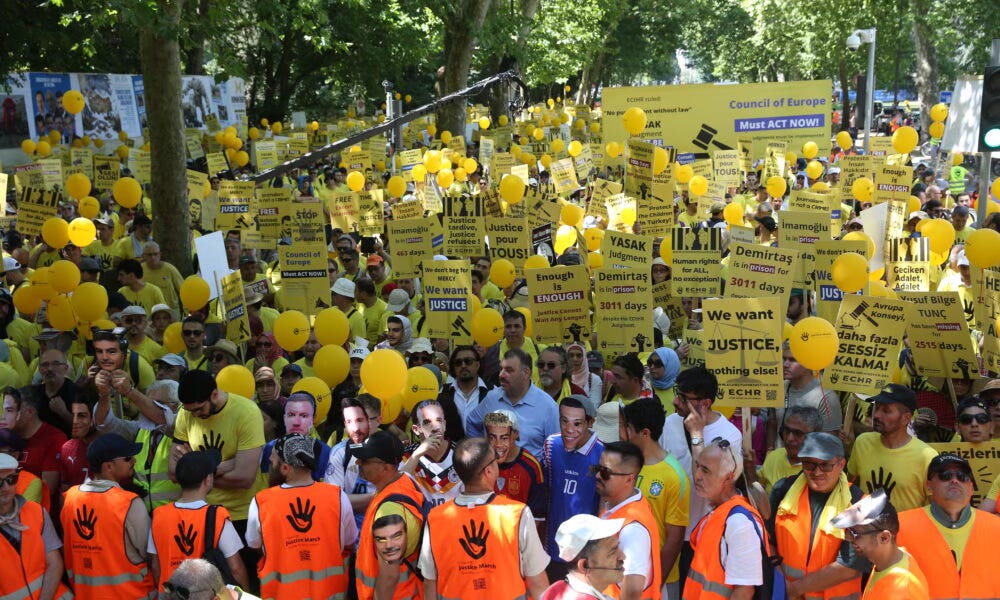
The significance of Strasbourg was not only institutional. It was also psychological.
For years, many victims of Turkey’s post-July 15 order have been made to feel isolated, stigmatized, or morally contaminated by accusation. The regime’s power lay not only in courts and decrees, but in its ability to make people believe that their suffering was unspeakable. Strasbourg disrupted that isolation. It placed individual stories next to one another until they formed a public record.
Former prisoners, journalists, dismissed teachers, mothers, families, and human rights defenders did not gather only to make legal demands. They gathered to say: this happened. It is still happening. And it cannot be buried under the language of national security.
That is how silence begins to break. Not all at once. Not through one heroic speech. But through accumulation. One testimony. One banner. One court judgment. One mother speaking about her child. One former teacher describing social death. One journalist insisting that journalism is not terrorism. One crowd refusing to disappear.
Yet, narrative reclamation does not only occur in the solemn, institutional theaters of international law. It also lives in the low-stakes, intimate spaces of culture, where a society’s collective subconscious quietly processes its trauma.
The same mechanism can emerge in unexpected cultural forms. A young comedian on a stage may appear, at first glance, far removed from legal advocacy in Strasbourg. Yet Deniz Göktaş’s recent stand-up performance on YouTube belongs to the same wider struggle over what can still be said in Turkey.
His performance matters not only because of the jokes themselves, but because of the atmosphere in which they are told. In a country where alternative speech is often equated with support for terrorism, where satire can become a legal matter, and where public figures learn to measure every sentence against possible consequences, the act of speaking freely acquires a meaning beyond entertainment.
On stage, the Turkish idiom ‘’“kellesi koltukta” was made literal: a giant head of him resting on an armchair.” ‘’Kellesi koltukta’’ means that he was doing that show with his life on the line. A young man on stage speaking fully aware of the risks but refuses to let fear write the script for him. He touches Turkey’s social fault lines, its political absurdities, its hypocrisies, its shared nervousness, its collective fatigue. He does not speak from the sterile distance of academic analysis. He speaks from inside the atmosphere.
At one point, he captures Erdoğan’s political evolution with devastating comic precision: Turkey has witnessed the development of Recep Tayyip Erdoğan from a shy autocrat into an autocrat at peace with himself.
The line lands because it compresses years of democratic erosion into a single image. It does not cite constitutional amendments, purges, emergency decrees, captured media, judicial dependency, or mass prosecutions. Yet it captures something essential: the psychological transformation of power.
Authoritarianism in Turkey did not arrive fully relaxed. It learned. It tested boundaries. It watched what society would tolerate. It became more confident, more expansive, more comfortable in its own skin. What may once have required denial gradually became performative certainty. What once had to be hidden behind democratic language began to speak in its own voice.
This is why the joke matters.
In Turkey’s current atmosphere, naming authoritarianism directly is no longer merely descriptive. It is an act of narrative resistance. The joke tells the audience not only that Erdoğan has changed, but that the change is visible, speakable, and collectively recognizable.
And that is precisely the Asch moment.
In the experiment, the dissenting person did not teach others how to see. They already saw. What the dissenter did was make it socially possible to trust one’s own perception again.
Good political comedy under authoritarian pressure does the same. It does not simply make people laugh. It restores shared perception. It allows an audience to realize that what they privately observed was not imagination, exaggeration, or madness. Others saw it too.
In that moment, laughter becomes more than laughter. It becomes a rehearsal for freedom.
This is where law, testimony, journalism, art, and humor meet. The legal struggle insists that rights violations be named precisely. Human rights reports document patterns and consequences. Strasbourg gives victims a public and institutional stage. Journalism prevents erasure. Comedy punctures the emotional monopoly of fear.
Together, they do what Asch’s lone dissenter did in the laboratory: they make unanimity less believable.
And once unanimity becomes less believable, society changes.
The task is not to produce a mirror image of propaganda. It is not to demand that everyone agree on one final version of the past. A democratic narrative does not require uniformity. On the contrary, it requires the right to disagreement. It requires a public sphere in which the state’s version of events can be questioned without the questioner being marked as an enemy.
It requires the distinction between violence and thought. Between crime and association. Between security and obedience. Between justice and revenge. Between memory and myth.
In Turkey, these distinctions have been systematically blurred. After July 15, the language of security expanded until it entered nearly every field of public life. Political opposition, civil society, journalism, education, property, family ties, humor, and memory could all be pulled into the orbit of suspicion. The result was not merely repression. It was an epistemic crisis: a crisis over who has the authority to define reality.
That is why reclaiming the narrative is not only about the past. It is about the future possibility of democracy.
A society cannot heal if it cannot speak honestly about what happened to it. It cannot restore justice if victims are forced to translate their suffering into the language of those who harmed them. It cannot rebuild institutions if the foundational myths of institutional destruction remain untouchable. And it cannot recover pluralism if alternative speech remains morally or legally coded as treason.
The courage required today is not only the courage to oppose. It is the courage to describe.
The people gathered in Strasbourg, the lawyers and writers documenting the post-July 15 order, the journalists still asking questions, the exiles preserving memory, and the comedian who makes audiences feel that something forbidden can still be said: all participate in the same fragile but vital act.
They break the illusion that everyone has accepted the official line.
And sometimes that is how history begins to move again: not when everyone speaks, but when one person speaks loudly enough for others to realize they were not alone in what they saw.
Reclaiming the narrative begins there. With the restoration of perception. With the end of enforced loneliness. With the refusal to call fear consensus. With the simple, dangerous, and liberating sentence: No. What we see is real. And it can be said.