

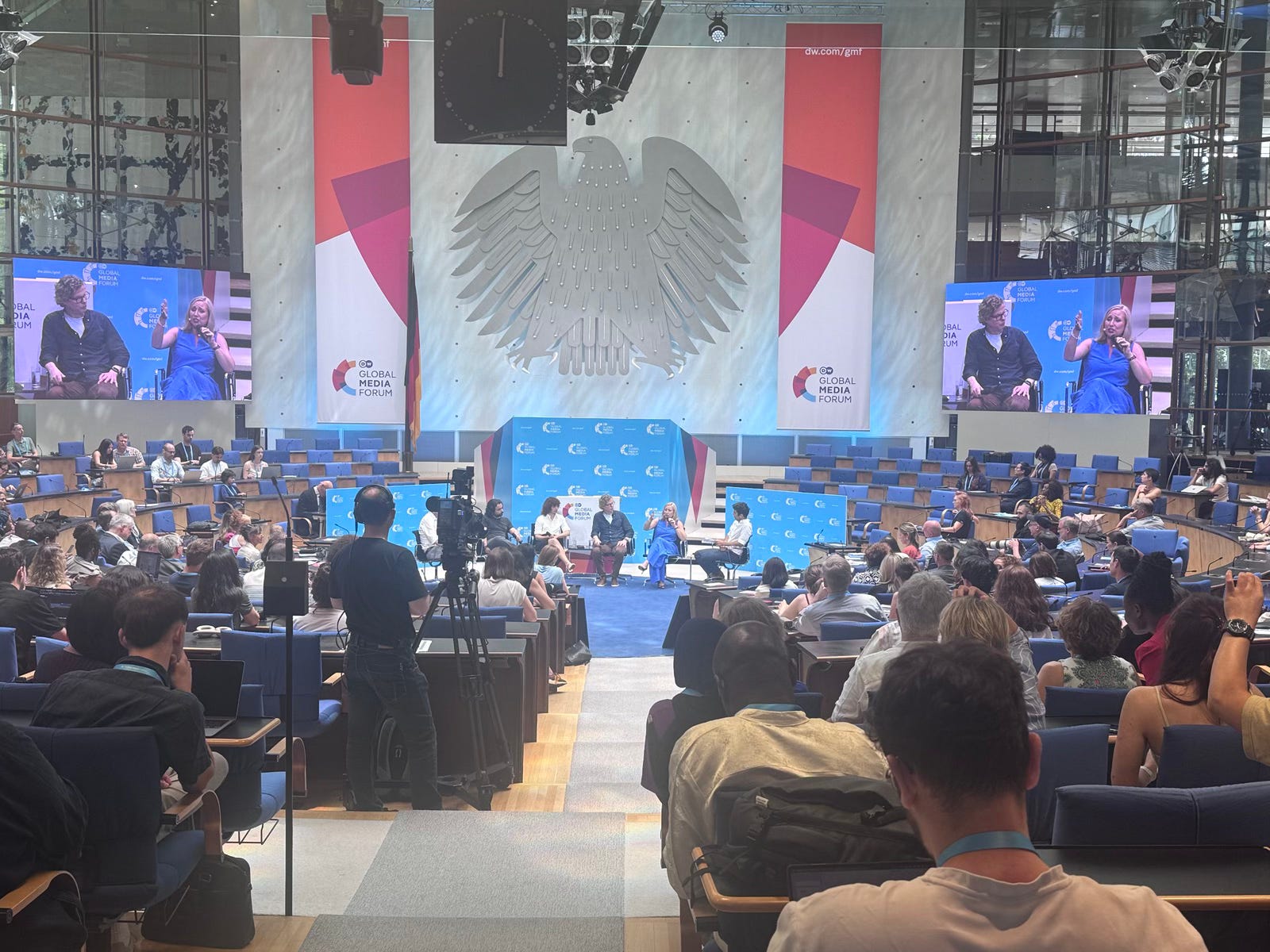
The official theme of this year’s DW Global Media Forum is “Journalism Out Loud.” Over the next two days, more than 1,400 journalists, policymakers, researchers and civil society representatives from over one hundred countries will discuss the challenges confronting media in an era shaped by artificial intelligence, political polarization and growing distrust in public institutions.
I found myself returning to a phrase that appeared almost incidentally during one of the opening sessions: an age of organized doubt.
The expression stayed with me because it seemed to describe something far larger than the difficulties facing journalism. It captures a broader transformation that has become visible across politics, science, public institutions and even everyday social relations. Increasingly, we live in societies where uncertainty is no longer simply a byproduct of complexity but has become a political and social force in its own right.
For much of modern history, power was closely linked to the control of information. Governments censored newspapers, restricted access to knowledge and attempted to dominate public narratives. The underlying assumption was straightforward: those who controlled information could influence public opinion. Today, however, the relationship between power and information appears to be changing. In many cases, the objective is no longer to convince citizens that a particular version of reality is true. It is to create so much confusion around competing claims that the very idea of a shared reality begins to weaken.
This shift has profound consequences:
Democratic societies depend on a certain degree of common ground. Citizens do not need to agree on every issue, but they need to share at least some confidence in the institutions that help establish facts, adjudicate disputes and produce knowledge. When that confidence erodes, public debate becomes increasingly difficult. Political disagreements cease to revolve around competing solutions and instead become conflicts over entirely different interpretations of reality.
One speaker at the forum captured this relationship between democracy, power and journalism with a striking observation: “Journalists are the fourth pillar of every democracy and the second pillar of every autocracy.”
The statement initially sounds paradoxical, yet it reveals an uncomfortable truth about the role of journalism in political systems. Democracies require an independent press because power needs to be scrutinized. Journalism functions as a mediating institution between citizens and authority, helping societies distinguish between claims and facts, promises and realities. In this sense, the media become part of the democratic architecture itself.
Autocracies, however, also depend on journalism—albeit in a fundamentally different way. Authoritarian systems cannot survive on coercion alone. They require narratives that legitimize power, explain away contradictions and manufacture consent. While democratic journalism seeks accountability, authoritarian journalism often seeks compliance. The same institution that can serve as a check on power in one context can become an instrument of power in another.
What makes the contemporary moment particularly complex is that the boundary between these two functions is becoming increasingly blurred. In an age of organized doubt, journalism is no longer challenged only by censorship or direct political interference. It is also challenged by the erosion of trust itself. When citizens cease to believe that any source of information is credible, the distinction between independent journalism and political messaging begins to lose its significance. The danger is not merely that people will believe propaganda. The greater danger is that they may stop believing that objective reporting is possible at all.
From a social psychological perspective, this development is particularly powerful because human beings have a limited tolerance for uncertainty. Faced with complex and rapidly changing environments, people naturally seek stability, coherence and meaning. They look for narratives that help them make sense of the world and communities that provide a sense of belonging. When traditional institutions lose credibility, individuals do not simply become more independent thinkers. More often, they begin searching for alternative sources of certainty, whether in charismatic leaders, online communities or simplified explanations that reduce complexity to emotionally satisfying stories.
This is one reason why organized doubt can be so effective. It exploits a deeply human need. Most people can live with disagreement, but very few can live comfortably with prolonged uncertainty. When societies lose confidence in established institutions, many citizens become vulnerable to actors who promise certainty, clarity and belonging. The attraction of such figures is not necessarily ideological. It is often psychological. In times of confusion, certainty itself becomes a form of power.
This phenomenon is not entirely new. Human societies have always relied on shared systems of meaning to maintain cohesion. Every culture develops stories, symbols and institutions that help people answer fundamental questions about who they are, whom they can trust and how they should interpret the world around them.
What is new is the scale and speed with which contemporary technologies can amplify doubt, reinforce existing beliefs and isolate people within increasingly fragmented information environments. Digital platforms connect billions of individuals, yet they often encourage forms of engagement that prioritize emotional reactions over careful reflection. The result is a paradoxical situation in which societies are more connected than ever before while simultaneously struggling to maintain a common understanding of reality.
The rise of artificial intelligence adds another layer to this challenge. AI has extraordinary potential to expand access to knowledge, improve communication and support journalism. Yet it also raises important questions about authority and authenticity. If information can be generated instantly, if images, videos and voices can be replicated convincingly, and if algorithms increasingly mediate what people see and know, then trust itself becomes an even more valuable social resource. The central issue is no longer whether information exists. The issue is whether people can determine which information deserves their confidence.
This was one of the underlying themes that surfaced repeatedly throughout the first day of the Global Media Forum.
Conversations about artificial intelligence, disinformation, platform power and the future of journalism all seemed to point toward the same fundamental question: how can trust be sustained in an environment where uncertainty is constantly produced, circulated and monetized?
The answer is unlikely to come from technology alone. Nor is it a challenge that journalism can solve by itself. Trust is ultimately a social achievement.
It emerges from institutions that demonstrate integrity, from public cultures that value accountability and from citizens who remain willing to engage with perspectives different from their own. Trust grows slowly, often over generations, yet it can be weakened surprisingly quickly when doubt becomes the dominant lens through which society interprets itself.
Perhaps this is why the phrase "organized doubt" feels so relevant. It reminds us that the central struggle of our time may not be over information itself, but over the conditions that make information meaningful. If journalism is indeed a pillar of democracy, as several speakers argued throughout the forum, then the erosion of trust is not merely a media problem. It is a democratic problem.
The future of open societies may depend less on producing more information and more on preserving the social and institutional foundations that allow citizens to trust it.
Bonn, June 2026